
Industrial pumps are among the most common rotating assets in industrial facilities and play a critical role in process continuity. They are used to transport cooling water, process fluids, chemicals, wastewater, and pulp stock throughout industrial processes. Whether operating in water treatment, power generation, chemical processing, or pulp and paper production, pump reliability directly affects production stability, operational efficiency, and maintenance costs.
Effective pump condition monitoring is therefore an important part of maintaining asset reliability. While individual pumps are often classified as medium-critical assets, their combined impact on plant performance is substantial. Unexpected failures can result in production losses, process disruptions, and increased maintenance costs.
The challenge
Industrial pumps rarely operate under constant conditions. Process demand, flow rate, pressure, and fluid characteristics can change continuously depending on operational requirements. These variations naturally influence vibration levels, making it difficult to determine whether changes in machine condition are caused by normal operating conditions or by developing mechanical problems.
At the same time, many common pump failures develop gradually. Bearing wear, shaft misalignment, rotor imbalance, and mechanical looseness often begin as small mechanical changes long before they become visible through process measurements such as flow, pressure, or temperature. Hydraulic phenomena such as cavitation can also introduce abnormal vibration patterns that may cause long-term damage if left undetected.
For maintenance teams responsible for large pump populations, periodic vibration measurements often provide only snapshots of machine condition. As a result, developing faults can remain unnoticed between inspection intervals, increasing the risk of unplanned downtime and secondary damage.
Why condition monitoring matters for pump reliability
Effective condition monitoring is essential for maintaining pump reliability and supporting condition-based maintenance programs. Process measurements such as flow, pressure, and temperature provide valuable operational information, but they do not always reveal developing mechanical problems.
Vibration monitoring provides direct insight into machine condition and is one of the most effective condition monitoring techniques for rotating equipment. Changes in vibration levels often appear before mechanical faults affect process performance, making vibration monitoring highly suitable for early fault detection.
Through continuous vibration monitoring, maintenance teams can identify developing bearing wear, shaft misalignment, rotor imbalance, mechanical looseness, and hydraulic issues such as cavitation. This allows maintenance activities to be planned based on actual machine condition instead of fixed maintenance intervals.
As part of a predictive maintenance strategy, pump condition monitoring improves asset reliability, reduces maintenance uncertainty, and helps prevent unexpected failures.
VibSys® for pump condition monitoring
Many industrial facilities operate dozens or even hundreds of pumps across different process areas. While these assets are important for production, they often do not justify the complexity or investment associated with traditional high-end monitoring systems. At the same time, manual vibration routes and basic monitoring devices frequently lack the continuity and diagnostic depth required for effective predictive maintenance.
VibSys® was developed to make continuous pump condition monitoring practical across large populations of industrial pumps. While traditional vibration analysis often relies on periodic measurements, VibSys® continuously acquires vibration data and converts it into clear condition indicators that can be monitored and analyzed over time.
Installed directly at the machine, VibSys® processes vibration data locally and provides reliable machine condition information without requiring complex monitoring infrastructure. This enables maintenance teams to identify developing mechanical degradation at an earlier stage and supports condition-based maintenance programs across a broader range of assets.
Because many industrial facilities operate pumps across multiple process areas, scalability is an important consideration. VibSys® can be installed close to the asset, reducing infrastructure requirements while providing continuous vibration monitoring and condition monitoring across large pump populations.
Open integration capabilities allow machine condition data to be incorporated into existing maintenance systems, dashboards, historians, and predictive maintenance workflows.
Typical VibSys® installations on pump
Horizontal centrifugal pumps
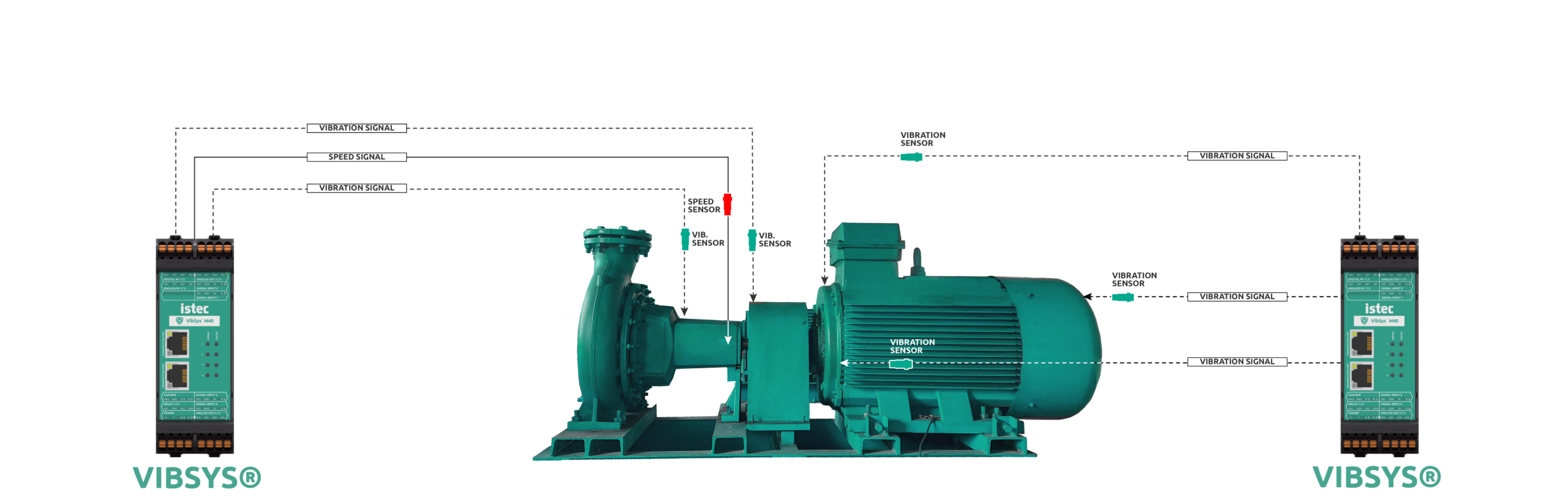
Horizontal centrifugal pumps are widely used for transporting water, process fluids, chemicals, and other liquids throughout industrial facilities. Vibration sensors are typically installed on both the motor and pump bearing locations to provide condition monitoring across the complete drivetrain. In this configuration, VibSys® continuously monitors vibration signals from critical measurement points, while an optional speed signal can provide additional diagnostic information. This enables early detection of bearing wear, shaft misalignment, rotor imbalance, mechanical looseness, and other developing faults that may affect pump reliability, availability, and maintenance costs.
Vertical pumps
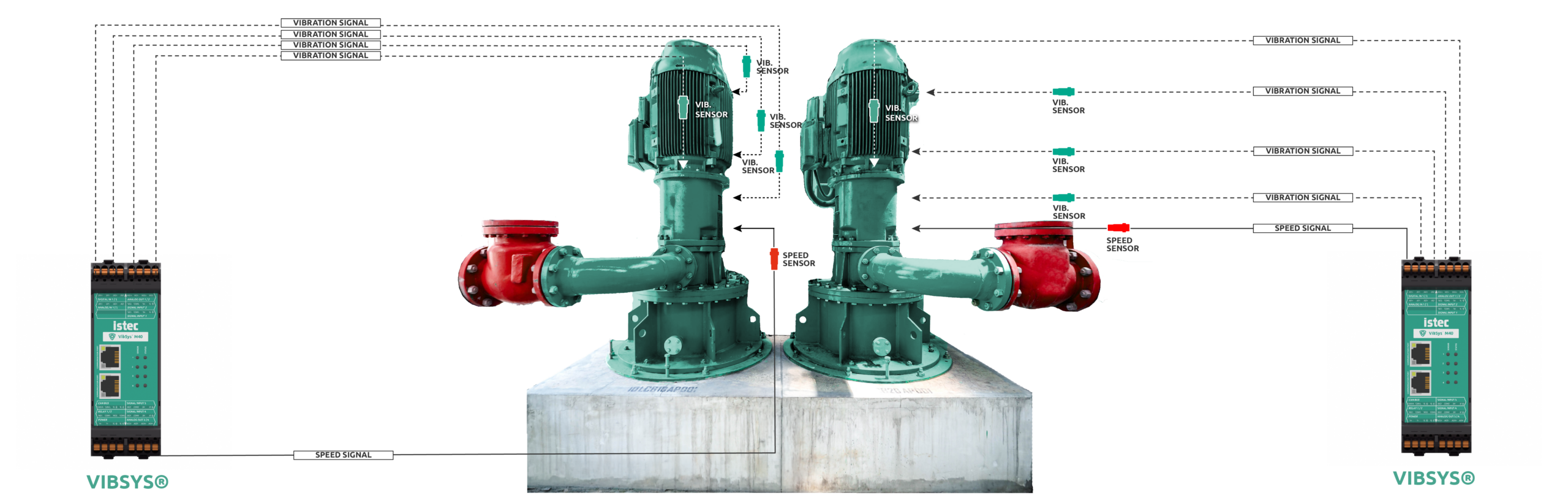
Vertical pumps often require multiple measurement locations due to their construction and bearing arrangement. Vibration sensors are typically installed on both the motor and pump assembly to provide a complete view of machine condition. In this configuration, VibSys® continuously monitors vibration signals from critical locations, while an optional speed measurement can provide additional diagnostic context. This supports early detection of bearing wear, misalignment, imbalance, and other developing mechanical issues that may affect pump reliability and availability.
Multi-pump installations
Key advantages for pump condition monitoring
- Continuous condition monitoring of industrial pump assets
- Early fault detection of developing mechanical degradation
- Improved visibility into bearing wear, misalignment, and imbalance
- Insight into hydraulic-related vibration patterns, including cavitation effects
- Scalable deployment across large pump populations
- Open integration with maintenance and predictive maintenance platforms
Impact on maintenance and reliability
Applying vibration monitoring with VibSys® helps maintenance teams transition from reactive maintenance to condition-based maintenance and predictive maintenance. Instead of responding to failures after they occur, machine condition can be monitored continuously, allowing maintenance interventions to be planned at an earlier stage.
This improves maintenance planning, reduces unplanned downtime, and helps prevent secondary damage to bearings, couplings, seals, and other critical pump components. It also allows maintenance resources to be focused on assets that actually show signs of degradation rather than relying solely on time-based maintenance intervals.
By expanding condition monitoring across industrial pump systems, organizations gain earlier insight into machine condition, improve pump reliability, and establish a stronger foundation for long-term rotating equipment reliability.
