

Not all rotating machines require the same vibration monitoring strategy, and not every machine problem should be addressed in the same way. A useful starting point is an asset criticality model: the right monitoring strategy depends on the consequences of failure, the operational role of the asset, and the level of diagnostic insight required. This also means that vibration monitoring does not serve the same purpose across every segment of the pyramid.
A practical way to structure the decision is to group assets into three segments, from highly critical at the top to operationally critical in the middle and low critical at the bottom. Each segment requires a different balance between monitoring depth, analysis effort, and the ability to act consistently on the results.
A helpful principle across all segments is escalation. Monitoring often starts with a basic method that provides sufficient coverage, then escalates when deviations persist or when the impact of failure increases. Escalation typically follows three steps: trend indication, continuous visibility, and specialist Bijgevoereview when relevant deviations are flagged for further analysis.
Highly critical assets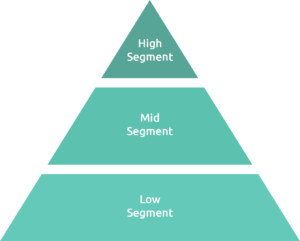
High impact machines with strict availability demands and low tolerance for uncertainty. Monitoring focuses on high confidence insight and specialist interpretation.
Operationally critical assets
Assets essential for production continuity and performance. Monitoring focuses on scalable condition-based decisions through continuous visibility and efficient analysis.
Low critical assets
Non-critical, low value assets where selective coverage and trend indication are sufficient. Monitoring is applied only where it adds practical value.
Highly critical assets
Strategy focus: operational availability and high confidence decision making.
Highly critical assets are machines where failure can lead to severe consequences and where tolerance for uncertainty is low. In this segment, the monitoring strategy is built around high confidence insight and a clear response model when limits are exceeded. Condition monitoring is used to provide early indication, diagnostic insight, and support for maintenance planning, but it is not intended to function as a safety mechanism itself.
To keep the strategy clear, it helps to separate responsibilities. Protection defines the operational response when limits are exceeded, while monitoring provides the insight that supports maintenance decisions, root cause analysis, and long-term reliability improvements.
Typical monitoring strategy in this segment:
- Continuous monitoring to maintain consistent visibility of condition development
- Specialist interpretation supported by validated data and consistent measurement practices
- Clear separation between protective response and condition-based decision support
- Escalation to deeper diagnostics when deviations persist or risk increases
In this segment, strategies that rely on intermittent data typically provide insufficient confidence for early detection and diagnostics, because gaps in visibility increase uncertainty when rapid degradation occurs.
Operationally critical assets
Strategy focus: condition-based maintenance at scale.
Operationally critical assets form the largest group in most industrial environments. These machines are essential for availability and performance. Failures often do not cause immediate safety consequences, but they do impact production continuity, efficiency, and maintenance cost. In this segment, organizations are increasingly moving from reactive and time-based maintenance toward condition-based decisions, especially where continuous monitoring and scalable analysis make this practical without creating a specialist workload that does not scale.
A practical strategy for this segment combines continuous condition monitoring with scalable analysis. The key is not that every signal is deeply analyzed, but that the system reliably identifies which assets require attention and when. This is commonly achieved by combining continuous measurement with local signal processing, followed by structured online analysis where automated first line screening flags which assets require further analysis. Specialist review is then applied when required, keeping specialist time focused on the cases where expert interpretation adds the most value.
This operating model is often best described as exception-based monitoring. Most assets remain in the background when behavior is stable, while deviations and exceptions trigger review and escalation. This makes monitoring programs scalable across larger asset groups.
Typical monitoring strategy in this segment:
- Continuous monitoring where diagnostic confidence is required
- Automated first line screening to flag assets that need review
- Specialist review when required for deeper diagnostics and decision support
- Remote review as standard practice to scale insight across sites and fleets
Wireless approaches can also be valuable in this segment for scalable screening and trend indication, but they can involve compromises in accuracy and measurement interval. This affects continuity and diagnostic depth when detailed fault development needs to be captured.
Low critical assets
Strategy focus: selective coverage and practical early indication.
Low critical assets are machines with limited impact on safety, environment, or production continuity. Failures are often manageable due to redundancy, low replacement cost, or limited process impact. In many cases, a run to failure strategy or basic periodic inspection is acceptable.
Where monitoring is applied, the strategy is usually to gain basic trend insight with minimal effort. Periodic measurements provide snapshots of machine behavior and can indicate whether an asset is stable or deserves closer attention. The trade-off is that snapshots do not provide full visibility of condition development between measurement moments, and short duration events may be missed.
Wireless monitoring is often a good fit in this segment because it scales coverage quickly and supports trend indication and early warning across large populations of similar assets. When repeated deviations occur, the strategy commonly escalates toward higher confidence monitoring or deeper review.
Typical monitoring strategy in this segment:
- Periodic monitoring for trend indication and selective coverage
- Wireless monitoring where rapid coverage and basic trending are the objective
- Escalation to continuous monitoring when repeated deviations increase risk or uncertainty
- Escalation to specialist review when diagnosis is required
How to choose the right strategy
Selecting the right vibration monitoring strategy should start with the intended outcome, not with hardware.
Key questions:
- What are the consequences of failure for this asset group, and how quickly must the organization respond?
- What level of diagnostic confidence is required to make maintenance decisions without unnecessary interventions?
- How many assets must be covered, and how will analysis be scaled without creating an unsustainable specialist workload?
A practical way to apply these questions is to use the escalation model as a guideline: start with basic trending, escalate to continuous monitoring when confidence must increase, and escalate to specialist review when diagnosis is required.
Periodic monitoring, continuous monitoring, automated first line screening, and expert review are not competing concepts. They are complementary methods that can be combined across asset groups. By starting with asset criticality and required decision confidence, organizations can apply vibration monitoring more consistently and effectively across the full asset base.
