
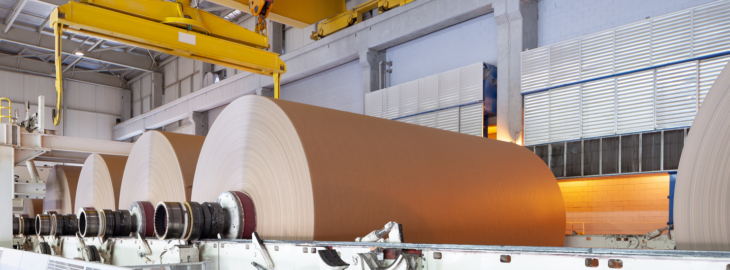
On a paper machine, mechanical condition is directly linked to runnability, sheet quality, and overall production stability. When a press roll starts to vibrate or a dryer fan excites the machine structure, the first effects are often visible in web breaks, draw instability, moisture profile variation, or increased felt and roll marking. These symptoms typically appear long before a mechanical failure occurs, but by then they already impact uptime and quality.
Paper machines operate continuously, with high stored energy and long restart times. Even relatively small degradations in rotating equipment reliability can therefore translate quickly into lost tonnes and missed delivery windows. From an asset reliability perspective, this makes vibration condition monitoring a practical and valuable tool for maintaining stable operation across the machine.
A modern paper machine combines multiple sections such as forming, press, dryer, calender, and reel, all connected through tightly coupled drive systems and auxiliaries. Typical assets include sectional drives, main drive systems, motors, gearboxes, roll and felt circuits, vacuum pumps, blowers, and large ventilation and hood fans. Many of these machines operate across a wide range of grades and speeds, with frequent start‑ups, threading events, and load changes. This operating variability is exactly why continuous vibration monitoring and diagnostics add value: they allow maintenance teams to distinguish normal process‑related behaviour from early mechanical degradation.
The challenge: coupled assets, variable operation, and vibration transfer
Paper machines bring together a large number of rotating assets on one long, mechanically connected frame. This makes them sensitive to common degradation mechanisms such as roll unbalance, fan unbalance, misalignment after roll changes, looseness in bearing housings, bearing lubrication issues, coupling wear, and gearbox tooth damage in sectional drives.
A practical complication is that vibration does not stay local. Excitation from one source can travel through housings, frames, foundations, and connected pipework, influencing measurements in neighbouring sections. Without continuous trending and diagnostic context, maintenance teams can easily end up reacting to symptoms rather than addressing the true root cause.
Operating conditions also change continuously. Speed ramps during start‑up, grade‑dependent loading, felt conditioning, steam and hood adjustments, and vacuum level changes all influence vibration levels and spectral content. The key question for reliability teams is therefore not whether vibration changes, but whether a change reflects normal operating variability or indicates early fault development. Answering that requires more than a single overall value; it requires stable indicators and sufficient data to support diagnostics.
Auxiliary systems often determine whether the machine runs stably. Blowers, trim and ventilation fans, vacuum pumps, condensate pumps, approach flow pumps, and supporting motors may be classified as mid‑critical individually, but failures in these systems can trigger web breaks, moisture instability, reduced drying capacity, or forced speed reduction. With high asset counts and many measurement points, paper mills need a scalable condition monitoring approach that can cover both the main drive systems and the surrounding auxiliaries, without the complexity of a traditional enterprise vibration system.
Why vibration monitoring matters on paper machines
Vibration monitoring is particularly effective on paper machines because many relevant failure mechanisms develop mechanically long before they appear in quality data or process alarms. Bearing wear, misalignment, imbalance, looseness, and gear defects all produce characteristic changes in vibration behaviour that can be detected early under real operating conditions.
For drive systems such as coater drives, dryer section drives, press drives, reeler drives, and main drive systems, vibration monitoring supports early detection of bearing and gearbox degradation before it affects speed stability or load sharing. In drivetrains, including motors and gearboxes, vibration trends provide insight into alignment condition, coupling wear, and developing gear damage. For air and vacuum systems, including fans, blowers, and vacuum pumps, vibration analysis detects imbalance, bearing wear, fouling, and structural issues that influence airflow, vacuum stability, and energy efficiency.
By continuously monitoring vibration across these asset groups, mills gain objective machine condition insight that complements process measurements and supports condition‑based maintenance and predictive maintenance.
Condition monitoring approach with VibSys®
VibSys® is a compact system for continuous vibration condition monitoring and diagnostics on rotating equipment. On paper machines, it is typically applied to sectional and main drives, gearboxes, roll‑related bearing housings, and critical auxiliaries such as fans, blowers, vacuum pumps, and process pumps. The goal is to provide stable, comparable machine condition indicators and diagnostic data that reliability teams can use for trending, early fault detection, and maintenance planning.
VibSys® acquires high‑quality vibration data and processes key indicators locally at the machine. This is particularly important on paper machines, where speed and load are not constant and where reliable trends are needed across grade changes and start‑up conditions. By extracting relevant features close to the source, VibSys® supports consistent monitoring of bearing condition, looseness, misalignment, and developing gear defects, while still enabling deeper diagnostics when abnormal trends appear.
For large machines with many measurement points, scalability is essential. VibSys® is designed for machine‑side installation, keeping wiring and infrastructure practical around press and dryer sections. Open data interfaces allow vibration indicators and, where required, full time‑signal data to be integrated with existing maintenance systems, historians, or analytics platforms. VibSys® is used strictly for condition monitoring and diagnostics to support maintenance decision‑making and is not intended for protection or shutdown functions.
- Continuous vibration condition monitoring across rollers, bearings, and drive systems
- Early fault detection of bearing wear, misalignment, imbalance, and looseness
- Stable condition indicators under changing production and operating conditions
- Distributed machine-side installation with minimal wiring requirements
- Suitable for demanding papermaking environments and high-temperature applications
- Open integration with PLC, MES, historian, and predictive maintenance platforms
- Scalable monitoring architecture for long and complex paper machine production lines
Impact on uptime, quality, and maintenance planning
Applying vibration condition monitoring with VibSys® on a paper machine supports a shift from reactive maintenance to condition‑based and predictive maintenance. Instead of discovering issues during breakdowns or after quality complaints, reliability teams gain early visibility into degradation patterns and can plan interventions around production constraints.
Continuous insight into machine condition helps prioritise actions such as replacing bearings before bearing housings are damaged, correcting misalignment after roll changes before vibration becomes recurrent, or addressing fan and pump unbalance before excessive loads are transmitted into the machine structure. This reduces unplanned stops, avoids secondary damage, and supports more predictable shutdown scopes and spare parts planning.
By trending vibration behaviour across both critical drive systems and the wider set of auxiliaries, mills strengthen rotating equipment reliability and long‑term control of machine condition. The result is fewer web breaks caused by mechanical instability, more stable operating windows, and improved quality consistency and energy‑efficient operation across the paper machine.
Free online vibration training
If your team is responsible for maintenance and reliability of rotating equipment in pulp and paper, basic vibration knowledge makes it easier to act on condition monitoring results. Istec provides a free Vibration Category 1 online training via the Istec Academy for professionals who want a practical introduction to vibration fundamentals and typical machine fault patterns.
Learn more »