

Shipping facilities, marine terminals, and bulk handling terminals depend on large numbers of rotating assets to keep materials moving safely and predictably. Pumps support fluid transfer and utility processes, fans provide ventilation and dust extraction, and gearboxes are widely used within conveying and material handling systems. Together with other rotating equipment, these assets contribute directly to loading, unloading, storage, and environmental control across the site. The reliability of this equipment has a direct influence on throughput and operational continuity. While many individual assets may be considered mid-critical, a developing mechanical problem can disrupt material flow, reduce available capacity, or affect supporting systems required for reliable terminal operation.
Shipping facilities are therefore a strong application for continuous vibration condition monitoring. By tracking changes in machine behavior over time, maintenance teams can identify developing mechanical problems earlier and make maintenance decisions based on actual machine condition rather than isolated measurements or fixed maintenance intervals.
The challenge: scale, environment, and limited visibility
Rotating equipment in shipping facilities operates under demanding environmental and operational conditions. Salt-laden air, humidity, dust, temperature variation, changing loads, and frequent start-stop cycles can all affect machinery and contribute to mechanical degradation.
At the same time, equipment is distributed across quays, conveyor galleries, transfer points, pump stations, storage areas, and enclosed buildings. This makes regular inspection and manual vibration measurement across the entire site time-consuming.
The challenge is therefore one of coverage as much as criticality. A terminal may contain many rotating assets that are individually straightforward to maintain but collectively essential to maintaining material flow. Periodic measurement routes provide only snapshots of their condition, leaving time between inspections in which bearing degradation, misalignment, imbalance, looseness, or other mechanical problems can develop.
Increasing measurement frequency manually also increases the inspection and analysis workload. For large and distributed terminal sites, a more scalable monitoring approach is needed to maintain visibility across the asset population.
Why vibration monitoring matters in terminal operations
Many mechanical problems in rotating equipment develop gradually and influence vibration behavior before they result in functional failure. Continuous vibration monitoring makes these changes visible as trends and provides maintenance teams with earlier insight into developing degradation.
This is particularly relevant in terminal operations because pumps, fans, and gearbox-driven equipment support different parts of the process but share many mechanical reliability challenges. Pumps maintain fluid transfer and utility processes, while fans support ventilation and dust extraction. Gearboxes transfer power throughout conveying and material handling systems that keep bulk materials moving through the terminal.
A change in the mechanical condition of these assets can therefore have consequences beyond the individual machine. Pump degradation can affect fluid transfer or availability, fan problems can reduce ventilation or dust extraction performance, and developing gearbox problems can ultimately disrupt material flow.
Vibration trends can reveal changes associated with bearing degradation, imbalance, misalignment, mechanical looseness, and gear-related wear. In pumps, vibration behavior can also provide information related to hydraulic conditions such as cavitation.
Because equipment may operate under changing loads and process conditions, individual measurements should always be interpreted in context. Continuous trending provides the history needed to distinguish temporary operating influences from persistent changes in machine behavior.
Applying VibSys® in shipping facilities and marine terminals
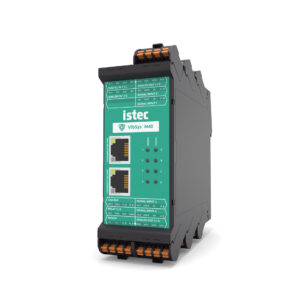
VibSys® is designed for continuous vibration condition monitoring across rotating equipment. Its compact, decentralized architecture enables high-quality vibration and supporting machine data to be acquired and processed close to the monitored equipment.
For large and distributed terminal sites, this makes it possible to increase monitoring coverage without requiring every measurement to be collected manually. Instead of relying primarily on periodic routes, maintenance teams gain continuous condition data across a broader population of rotating assets.
VibSys® processes vibration signals locally into structured and usable information while retaining detailed vibration data for further diagnostic analysis when required. This provides a consistent data foundation for identifying, trending, and prioritizing changes in machine condition.
Open connectivity allows condition information to be incorporated into existing plant, maintenance, or analysis environments. This is particularly relevant at terminals where equipment from different suppliers, generations, and systems must often be managed within the same maintenance strategy.
The scalable architecture also allows monitoring to begin with a selected group of rotating assets and expand over time. This enables terminals to increase monitoring coverage where continuous condition insight provides the most value without implementing a large centralized monitoring infrastructure at once.
VibSys® is intended for condition monitoring and diagnostics to support maintenance decision-making. It does not replace dedicated machine protection or safety-related shutdown systems.
Key advantages for shipping facilities and marine terminals
- Continuous vibration condition monitoring across distributed rotating assets
- Earlier visibility into developing mechanical problems
- Consistent machine-condition trends instead of isolated periodic measurements
- High-quality vibration data available for further diagnostic analysis
- Local data processing close to the monitored equipment
- Open connectivity for integration with existing plant and analysis environments
- Scalable deployment across large terminal sites
- Reduced dependency on manual vibration measurement routes
- More efficient use of maintenance and vibration expertise
- A practical foundation for condition-based and predictive maintenance
Impact on maintenance and terminal reliability
Continuous vibration condition monitoring gives maintenance teams greater visibility into the condition of rotating equipment across the terminal.
Developing changes can be identified earlier, allowing maintenance to be planned before deterioration causes a larger mechanical problem or interrupts terminal operations. Instead of repeatedly inspecting every asset at the same frequency, maintenance teams can focus attention on equipment that shows changing or abnormal behavior.
For large sites with assets spread across different operational areas, this also helps prioritize available maintenance resources. Inspection and specialist analysis can be directed toward the machines that require attention while continuous monitoring maintains visibility across a broader asset population.
The result is a more predictable maintenance approach and a stronger basis for maintaining equipment availability and consistent terminal operations.
From periodic measurements to scalable condition monitoring
Large terminals can contain more rotating equipment than can practically be covered through frequent manual vibration measurements. Increasing coverage with traditional routes also increases measurement and analysis workload.
Continuous monitoring changes this approach. Vibration data can be collected without requiring someone to be present at each machine for every measurement, allowing maintenance and reliability specialists to spend more time assessing relevant changes and determining appropriate maintenance actions.
For distributed terminal operations, a scalable monitoring architecture makes it possible to extend condition insight across more rotating equipment without proportionally increasing routine inspection work.
Increase monitoring coverage with VibSys®
For terminal operators, improving rotating equipment reliability is not only about preventing individual failures. It is also about maintaining visibility across a large and distributed asset population, identifying which machines require attention, and using maintenance resources efficiently.
VibSys® provides a scalable foundation for expanding that visibility. Continuous vibration acquisition, local processing, high-quality diagnostic data, and open connectivity make it possible to increase monitoring coverage without creating an equivalent increase in manual measurement work.
Monitoring can start with a selected group of rotating assets where continuous insight can improve maintenance decisions and then expand across additional equipment or operational areas.
This enables maintenance and reliability teams to monitor more rotating equipment, from pumps and fans to gearboxes and other driven machinery, identify relevant changes earlier, and focus specialist expertise where it provides the most value.
