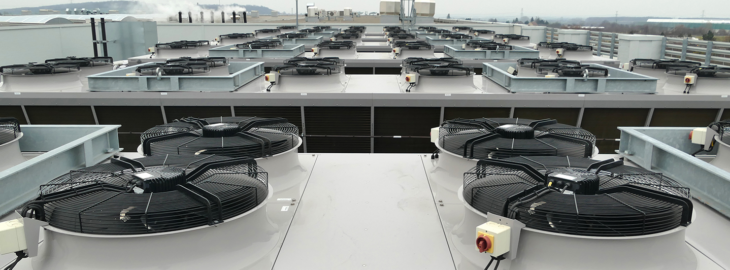
Industrial fans are essential assets in a wide range of industries, including power generation, chemical processing, manufacturing, HVAC systems, waste-to-energy plants, and data centers. They are responsible for moving air, exhaust gases, and process media that are critical to operational continuity. As a result, fan reliability directly affects process stability, energy efficiency, equipment availability, and maintenance costs.
Many facilities operate large numbers of fans distributed across different process areas. While individual units are often classified as medium-critical assets, their combined impact on production and maintenance workload can be substantial. Effective condition monitoring is therefore an important part of maintaining asset reliability and supporting long-term rotating equipment reliability.
The challenge
Industrial fans are exposed to a variety of mechanical and operational stresses. Changes in airflow demand, process conditions, contamination buildup, and continuous operation all influence machine condition over time. In many applications, fans operate continuously, making unexpected failures particularly disruptive.
Common failure mechanisms include bearing wear, rotor imbalance, shaft misalignment, mechanical looseness, and structural vibration issues. In centrifugal fans, dust or material buildup can gradually introduce imbalance, while bearing degradation may develop unnoticed until vibration levels become significant. Axial fans can also experience blade-related problems that affect performance and reliability. For many organizations, fan condition is still assessed through periodic inspections or manual vibration routes. These approaches provide only snapshots of machine condition, meaning developing faults can remain undetected between inspection intervals.
Why vibration monitoring matters for industrial fans
Vibration monitoring is one of the most effective condition monitoring techniques for industrial fans because changes in vibration behavior are often among the earliest indicators of developing mechanical problems. Vibration data provides direct insight into machine condition and enables maintenance teams to identify degradation before performance is affected. Continuous vibration monitoring supports early fault detection of bearing wear, imbalance, misalignment, mechanical looseness, and resonance-related vibration. By monitoring trends over time, maintenance teams can identify changes in machine condition and plan maintenance activities before failures occur. Compared to reactive maintenance or periodic inspections, continuous vibration monitoring provides a more complete understanding of machine condition. This supports condition-based maintenance and predictive maintenance strategies while improving overall asset reliability.
VibSys® for industrial fan condition monitoring
Industrial fan installations often consist of many distributed assets spread throughout a facility. Traditional monitoring systems can become difficult to scale due to infrastructure requirements, installation complexity, and cost.
VibSys® was developed to make continuous vibration monitoring practical across a broad range of rotating equipment, including industrial fan applications. Installed directly at the machine, VibSys® continuously acquires vibration data and converts it into clear condition indicators that can be monitored and analyzed over time. Its compact DIN-rail design allows installation close to the asset, reducing cabling requirements and supporting distributed monitoring architectures. Vibration data is processed locally while remaining available for integration with maintenance systems, dashboards, historians, and third-party analysis platforms through open interfaces. This approach enables maintenance teams to expand condition monitoring coverage across larger fan populations without the complexity typically associated with traditional high-end monitoring systems.
Typical VibSys® installations on industrial fans
Industrial fan installations vary depending on the application, airflow requirements, and fan design. VibSys® can be applied to a wide range of fan configurations, from belt-driven systems to large process fans and axial ventilation fans. The examples below illustrate typical condition monitoring configurations for common industrial fan installations.
Belt-driven centrifugal fans
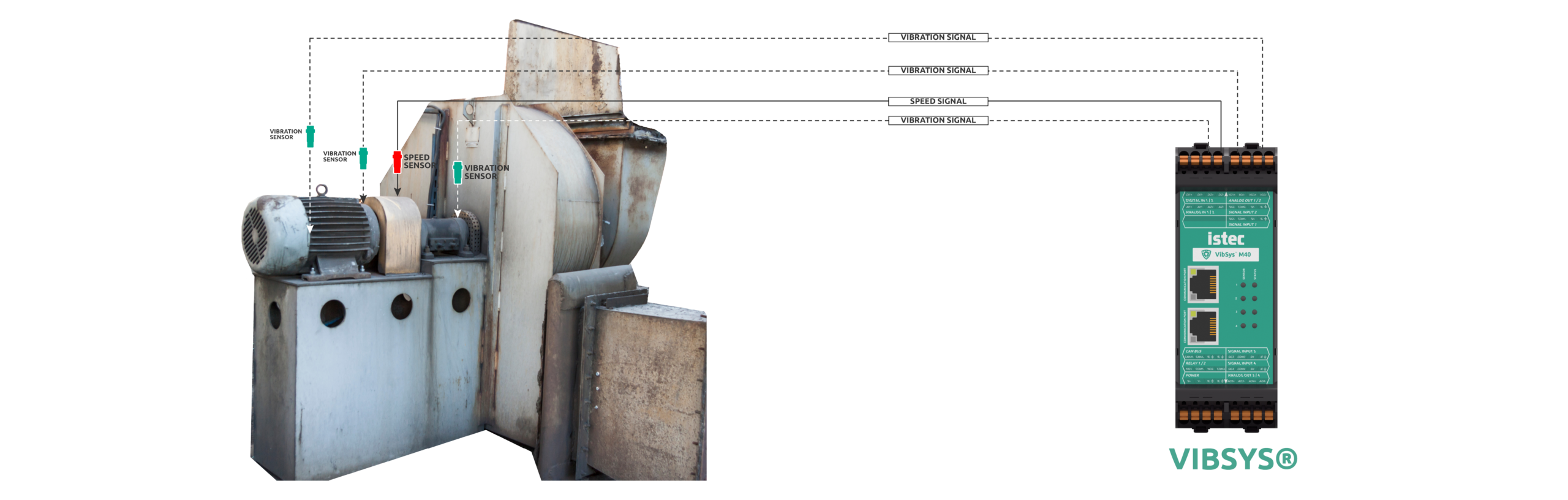
Belt-driven centrifugal fans are commonly used in industrial ventilation, exhaust systems, and process air applications. Because the drivetrain consists of a motor, belt transmission, bearings, and fan rotor, multiple vibration measurement locations are typically required to monitor the complete rotating assembly. VibSys® continuously monitors vibration signals from critical points throughout the drivetrain, while an optional speed measurement provides additional diagnostic information. This supports early detection of bearing wear, pulley misalignment, belt-related issues, rotor imbalance, and mechanical looseness that may affect fan reliability, efficiency, and equipment availability.
[Click to enlarge]
Axial fans
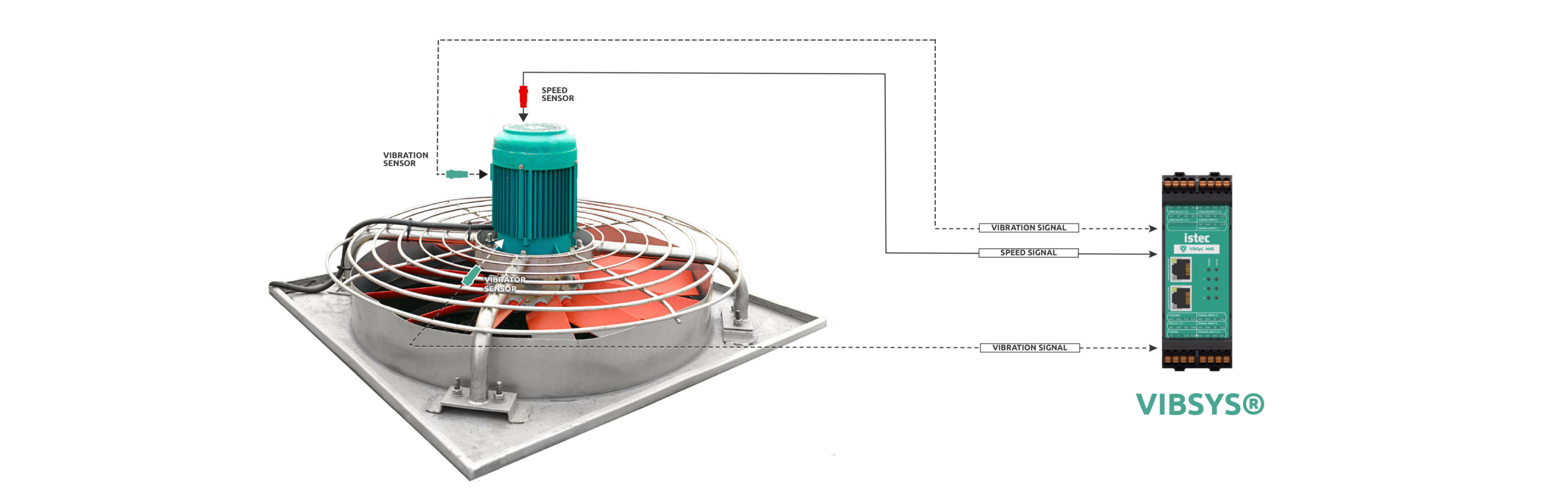
Axial fans are widely used in HVAC systems, cooling installations, and industrial ventilation applications. Air flows parallel to the rotating shaft, allowing large air volumes to be moved efficiently. VibSys® continuously monitors vibration signals from both the motor and fan assembly, while an optional speed measurement provides additional diagnostic information. This supports early detection of bearing wear, rotor imbalance, mechanical looseness, and blade-related issues before they affect performance, energy efficiency, or equipment reliability.
Direct-coupled centrifugal fans
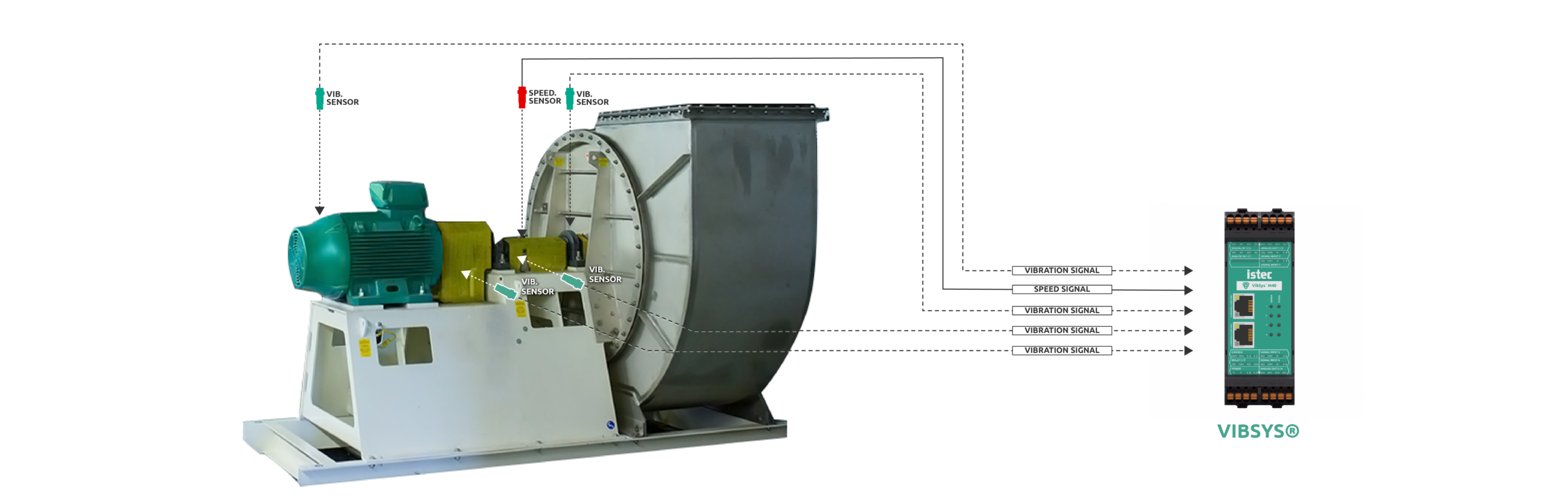
Direct-coupled centrifugal fans use a flexible coupling to connect the motor directly to the fan shaft, eliminating belts and pulleys from the drivetrain. This configuration reduces maintenance requirements while providing efficient power transmission for industrial ventilation and process air applications. VibSys® continuously monitors vibration signals from the motor, coupling, and fan bearing locations, while an optional speed measurement provides additional diagnostic information. This supports early detection of bearing wear, coupling misalignment, rotor imbalance, and mechanical looseness that may affect fan reliability, efficiency, and equipment availability.
[Click to enlarge]
Key advantages
- Continuous vibration monitoring of industrial fan systems
- Early fault detection of bearing wear, imbalance, and misalignment
- Improved visibility into machine condition and degradation trends
- Scalable deployment across large numbers of distributed fan assets
- Machine-side installation with limited infrastructure requirements
- Open integration with maintenance and predictive maintenance platforms
Impact on maintenance and reliability
Applying vibration monitoring with VibSys® enables maintenance teams to move from reactive maintenance toward condition-based maintenance and predictive maintenance strategies. Machine condition can be monitored continuously, allowing potential problems to be identified long before they affect production or process performance. Earlier fault detection improves maintenance planning, reduces unplanned downtime, and helps prevent secondary damage to bearings, couplings, shafts, and fan components. Maintenance resources can be focused on assets that show actual signs of degradation instead of relying solely on time-based inspection intervals. By expanding condition monitoring across industrial fan installations, organizations improve asset reliability, increase equipment availability, and create a stronger foundation for long-term rotating equipment reliability.