
Industrial compressors play a critical role in a wide range of industries, including oil and gas, chemical processing, power generation, manufacturing, refrigeration, and process industries. They provide the compressed air and process gases required for production, transportation, cooling, and operational continuity. As a result, compressor reliability directly influences process stability, equipment availability, energy efficiency, and maintenance costs.
Many facilities depend on compressors as essential rotating assets within their production processes. Even brief interruptions can result in reduced output, process disruptions, or costly downtime. Effective condition monitoring is therefore a key element in maintaining asset reliability and supporting long-term rotating equipment reliability.
The challenge
Industrial compressors operate under demanding conditions that place continuous stress on mechanical components. Variations in load, pressure, temperature, and process demand all influence machine condition throughout the operating lifecycle. In many applications, compressors run continuously for extended periods, making unexpected failures particularly disruptive.
Common failure mechanisms include bearing wear, rotor imbalance, shaft misalignment, coupling defects, lubrication problems, mechanical looseness, and resonance-related vibration. In centrifugal compressors, rotor dynamics and bearing condition are often critical reliability factors. Reciprocating compressors introduce additional challenges due to cyclic loading, crosshead wear, valve degradation, and complex vibration characteristics associated with the reciprocating motion.
For many organizations, compressor condition is still assessed through periodic inspections or route-based vibration measurements. While these approaches provide valuable information, they only offer a snapshot of machine condition. Developing faults can therefore remain undetected between inspection intervals, increasing the risk of unplanned downtime and secondary equipment damage.
Why vibration monitoring matters for industrial compressors
Vibration monitoring is one of the most effective condition monitoring techniques for industrial compressors because vibration behavior changes as mechanical degradation develops. Vibration data provides direct insight into machine condition and often reveals developing faults long before operational performance is affected.
Continuous vibration monitoring supports early fault detection of bearing wear, rotor imbalance, shaft misalignment, looseness, lubrication-related problems, coupling defects, and resonance issues. By monitoring vibration trends over time, maintenance teams gain visibility into asset condition and can identify degradation before failures occur.
Compared to reactive maintenance strategies, manual inspections, or periodic monitoring routes, continuous vibration monitoring provides a far more complete understanding of machine condition. This enables condition-based maintenance and predictive maintenance strategies while improving overall asset reliability and reducing maintenance uncertainty.
VibSys® for industrial compressor condition monitoring
Compressors are often installed throughout production facilities, utility networks, and process units. Expanding condition monitoring across multiple machines can become challenging when traditional monitoring systems require extensive infrastructure, centralized cabinets, or complex installation projects.
VibSys® was developed to make continuous vibration monitoring practical across a broad range of rotating equipment, including industrial compressor applications. Installed directly at the machine, VibSys® continuously acquires vibration data and converts it into clear condition indicators that can be monitored and analyzed over time.
Its compact DIN-rail design allows installation close to the asset, reducing cabling requirements and supporting distributed monitoring architectures. Vibration data is processed locally while remaining available for integration with maintenance systems, dashboards, historians, and third-party analysis platforms through open interfaces.
This approach enables maintenance teams to expand vibration monitoring coverage across compressor fleets while maintaining visibility into machine condition and supporting predictive maintenance initiatives.
Typical VibSys® installations on industrial compressors
Industrial compressor installations vary considerably depending on compressor type, process requirements, and operating conditions. VibSys® can be applied to a wide range of compressor configurations, from centrifugal compressors to reciprocating compressor systems. The examples below illustrate typical monitoring configurations.
Centrifugal compressors
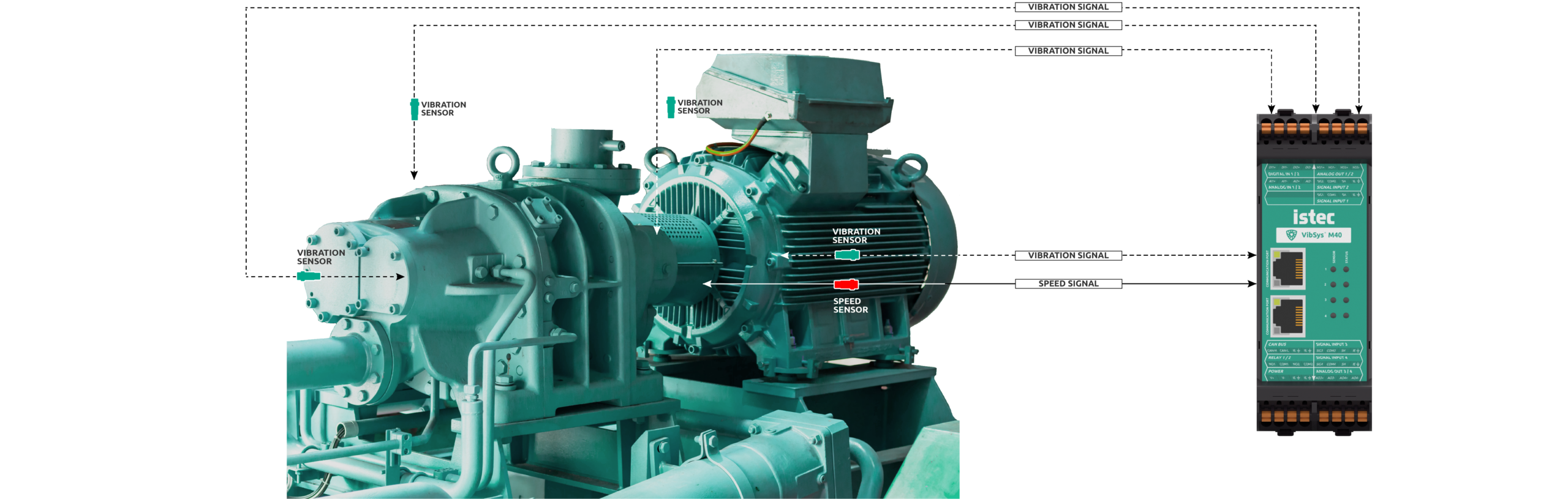
Centrifugal compressors are widely used in process industries, petrochemical facilities, gas transport systems, and power generation applications. These high-speed machines depend heavily on rotor stability and bearing condition to maintain reliable operation.
VibSys® continuously monitors vibration signals from critical bearing locations on both the compressor and driver. An optional speed measurement provides additional diagnostic information that supports machine analysis and condition assessment.
This configuration supports early detection of bearing degradation, rotor imbalance, shaft misalignment, coupling defects, mechanical looseness, and developing rotor dynamic issues before they impact performance, efficiency, or availability.
Reciprocating compressors
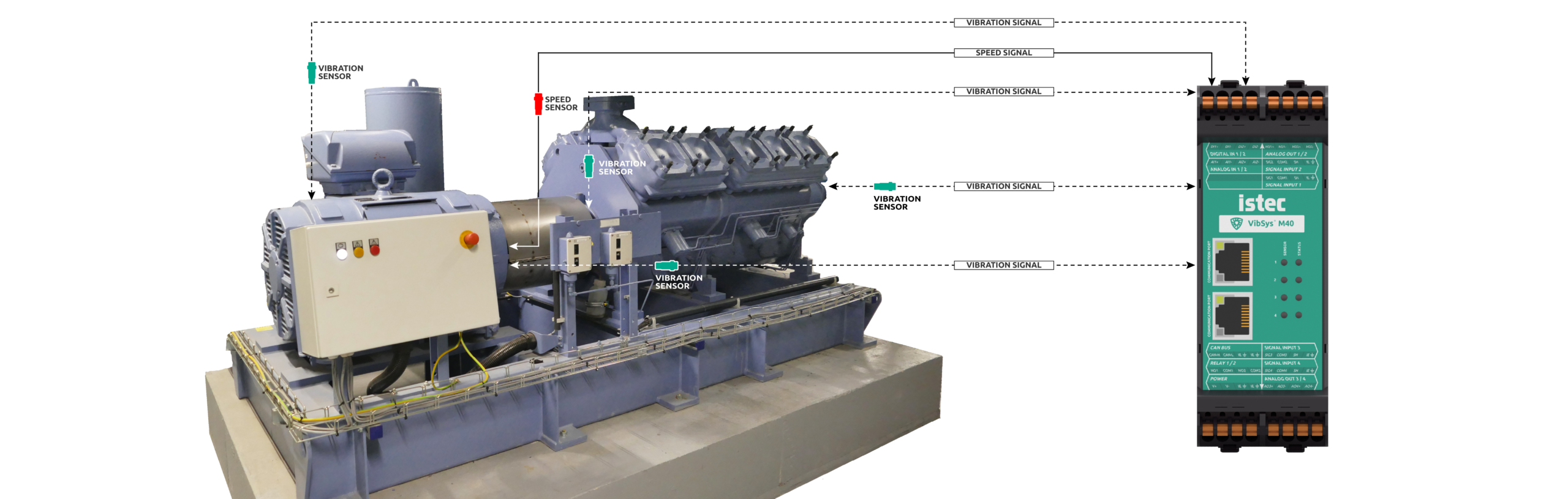
Reciprocating compressors are commonly used for high-pressure gas compression in industrial processing, gas handling, refrigeration, and chemical applications. Their reciprocating motion introduces unique vibration characteristics and multiple mechanical components that require effective condition monitoring.
VibSys® continuously monitors vibration signals on critical machine locations, including frame, bearing, and cylinder-related measurement points. An optional speed measurement provides additional diagnostic information and operating context.
This supports early detection of valve degradation, bearing wear, crosshead wear, looseness, misalignment, and other developing mechanical issues before they lead to reduced reliability or unplanned downtime.
Key advantages
- Continuous vibration monitoring of industrial compressor systems
- Early fault detection of bearing wear, imbalance, and misalignment
- Improved visibility into compressor condition and degradation trends
- Scalable deployment across distributed compressor installations
- Machine-side installation with limited infrastructure requirements
- Open integration with maintenance and predictive maintenance platforms
Impact on maintenance and reliability
Applying vibration monitoring with VibSys® enables maintenance teams to move from reactive maintenance toward condition-based maintenance and predictive maintenance strategies. Machine condition can be monitored continuously, allowing potential problems to be identified long before they affect production, process stability, or compressor performance.
Earlier fault detection improves maintenance planning, reduces unplanned downtime, and helps prevent secondary damage to bearings, couplings, rotors, valves, and other critical compressor components. Maintenance resources can be focused on assets that show actual signs of degradation instead of relying solely on fixed inspection intervals.
By expanding condition monitoring across industrial compressor installations, organizations improve asset reliability, increase equipment availability, and create a stronger foundation for long-term rotating equipment reliability.
