
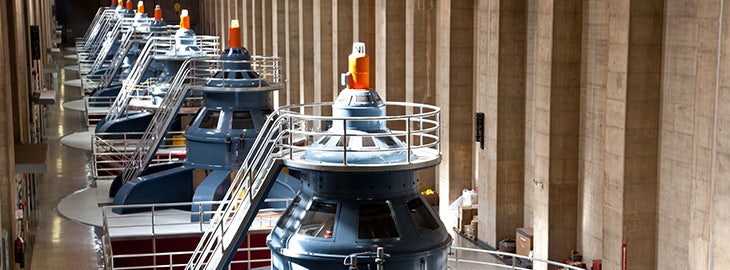
Hydro power generation depends on the reliable operation of rotating equipment that often operates continuously under changing hydraulic conditions. While hydro turbines are central to electricity generation, overall plant performance also depends on supporting assets such as generators, pumps, gearboxes, and auxiliary fans. Together, these assets influence plant availability, maintenance requirements, and long-term asset reliability.
Many hydro power plants operate in remote or difficult-to-access locations where unexpected equipment failures can have a significant operational impact. Continuous vibration monitoring helps maintenance teams gain visibility into machine condition and detect developing faults before they affect reliability, production, or maintenance planning. VibSys® is designed to make condition monitoring practical across these distributed and often challenging environments.
The challenge: remote assets and variable operating conditions
Hydro turbines and supporting rotating equipment are exposed to constantly changing operating conditions. Variations in water flow, generation demand, seasonal conditions, and load changes can all influence machine behaviour and vibration characteristics.
Within hydro power plants, Generators convert turbine power into electricity, while pumps support cooling, lubrication, drainage, and auxiliary systems. Gearboxes may be used in supporting drives and auxiliary processes, while Fans help maintain cooling and ventilation systems. Although these assets may be considered mid-critical individually, their combined impact on plant performance is substantial.
Because many hydro facilities are located in remote areas, regular manual inspections can be time-consuming and costly. Developing faults such as bearing wear, imbalance, misalignment, looseness, and gearbox degradation may therefore remain undetected between inspection intervals. Improving visibility into machine condition is a key challenge for maintenance and reliability teams.
Why vibration monitoring matters in hydro power generation
Vibration monitoring is one of the most effective techniques for assessing the condition of rotating equipment. Most mechanical faults develop gradually and generate detectable vibration signatures long before functional failure occurs. This makes vibration monitoring a valuable tool for early fault detection and predictive maintenance.
For hydro turbines and Generators, vibration monitoring can reveal developing bearing defects, misalignment, looseness, and other machine condition issues before reliability is affected. For auxiliary Gearboxes, vibration analysis helps identify gear wear and bearing degradation at an early stage.
Continuous vibration monitoring of Pumps allows maintenance teams to detect bearing damage, hydraulic-related vibration effects, and imbalance before equipment performance is impacted. Similarly, monitoring Fans can help identify developing imbalance, structural looseness, and bearing wear.
By identifying these issues early, operators can move from reactive maintenance towards condition-based maintenance strategies based on actual machine condition. This improves maintenance planning and supports long-term rotating equipment reliability.
Applying VibSys® in hydro power generation
VibSys® is designed to provide scalable vibration monitoring for rotating equipment operating in demanding industrial environments. The system combines continuous data acquisition, local signal processing, and centralized diagnostics, making it particularly suitable for hydro power applications where assets may be distributed across remote locations.
Within hydro power plants, VibSys® can be applied across hydro turbines, Generators, Pumps, Gearboxes, Fans, and other supporting rotating equipment. The compact architecture allows installation close to the machine, reducing infrastructure requirements while enabling continuous condition monitoring.
A key advantage for hydro operators is the ability to extend vibration monitoring beyond only the most critical assets. VibSys® helps create broader visibility across the entire rotating equipment population, enabling maintenance teams to detect problems earlier and make more informed maintenance decisions.
The system continuously collects vibration data and performs local processing at machine level. This allows anomalies to be identified quickly while detailed diagnostic data remains available for further analysis. For remote hydro facilities, this approach reduces reliance on periodic inspections while improving visibility into machine condition across the site.
VibSys® also supports integration with existing maintenance platforms, SCADA environments, and reliability programs through open interfaces. This enables vibration monitoring to become part of a broader predictive maintenance strategy without introducing unnecessary complexity.
VibSys® is intended for condition monitoring and diagnostics. It supports maintenance decision-making by providing continuous machine condition insight and early fault detection but is not intended to function as a machine protection or shutdown system.
Key advantages
- Continuous vibration monitoring of Generators, Pumps, Gearboxes, and Fans.
- Early fault detection of bearing wear, imbalance, misalignment, and gear-related degradation.
- Suitable for remote and difficult-to-access hydro power installations.
- Local signal processing for fast and practical machine condition assessment.
- Scalable deployment across multiple hydro assets and supporting systems.
- Open integration with maintenance, reliability, and operational platforms.
Impact on maintenance and reliability
Applying vibration monitoring with VibSys® gives maintenance teams earlier visibility into the condition of hydro turbines and supporting rotating equipment throughout the facility. Instead of discovering issues during breakdowns or scheduled inspections, operators gain continuous insight into developing faults across Generators, Pumps, Gearboxes, and Fans.
In practice, this supports a shift from reactive maintenance towards condition-based maintenance. Maintenance activities can be prioritised based on actual machine condition, helping reduce unplanned downtime, optimize service intervals, and improve maintenance efficiency.
For hydro power generation facilities, continuous vibration monitoring provides a practical foundation for predictive maintenance, improved rotating equipment reliability, and greater operational confidence across both generation assets and supporting equipment.
